
The Art of Bringing a Kitchen Together
Many people start by choosing the kitchen itself. They find a door style they love, pick a worktop that catches their eye and begin making decisions one element at a time. In reality, that’s not how a well-designed kitchen comes together.
The most successful kitchens aren’t built around individual products. They’re created by considering how every finish, material and colour will work together before anything is ordered.
Looking at the Whole Picture
When we’re designing a kitchen, we’re never just thinking about the cabinetry.
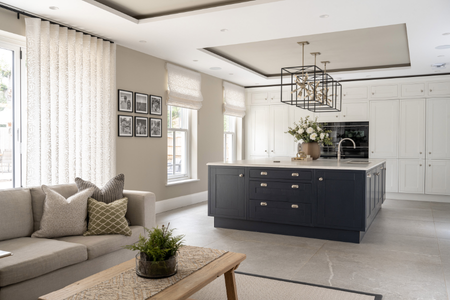
Long before a design is signed off, we’re already considering the flooring, worktops, wall colours, hardware and lighting. Every decision influences the next, and it’s only by seeing them together that you can be confident they’ll create the look you’re hoping for.
It’s surprisingly easy to fall in love with a beautiful worktop or a particular kitchen display in a showroom. The challenge comes when those individual choices are brought together in your own home and how they might relate to any adjacent rooms or spaces.
A kitchen doesn’t exist in isolation. Every material has to relate to the others, creating a space that feels balanced rather than a collection of separate decisions.
Why Contrast Matters More Than Matching
One of the biggest misconceptions in kitchen design is that everything should coordinate as closely as possible.
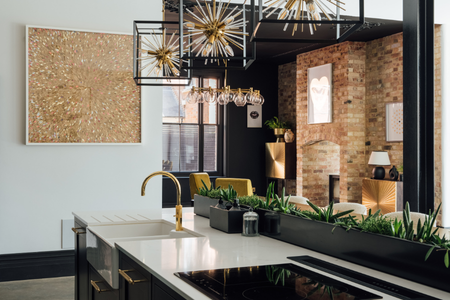
In reality, contrast is often what gives a kitchen its character.
Contrast isn’t simply about choosing different colours. It’s about creating enough variation in tone and texture so each element has its own place within the design. Your cabinetry, worktops, flooring and wall colours should complement one another, but they also need enough distinction to stop the room feeling flat.
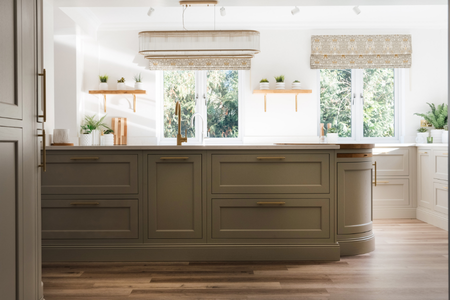
This is where mid-toned kitchens can become surprisingly challenging.
Many people assume they’re the safest option because they sit comfortably between light and dark. In practice, they can actually be one of the trickiest palettes to work with. When the cabinets, flooring and walls all sit within a similar tonal range, the whole room can lose definition.
That doesn’t mean you should avoid a mid-toned kitchen. Far from it. It simply means the surrounding finishes need even more careful consideration. Sometimes the answer is introducing a much lighter wall colour, a darker worktop or flooring that creates the contrast needed for the whole scheme to come to life.
These are exactly the kinds of design decisions that happen behind the scenes before a single cabinet is ordered.
Designing for Today — and Tomorrow
A new kitchen is a significant investment, so it’s worth thinking beyond how it will look on the day it is installed.
Some elements are relatively simple to update over time. Walls can be repainted, handles can be replaced and even cabinetry can often be refreshed with a new colour in years to come.
Flooring is a different story.
Replacing a kitchen floor is far more disruptive and expensive, so it’s worth choosing something with longevity. Additionally, if you even think it’s a possibility you might replace the kitchen in the future but not change the floor, it’s essential you run the floor under all of the units and cover the full floor. It may be more cost-effective to run the floor up to the units, but it limits any future kitchen to the same layout unless the floor is replaced.
Designing with that flexibility in mind means your kitchen has the opportunity to evolve with your home and your style over the years.
The Design Work You Never See
One of the most valuable parts of interior design happens before any products are ordered.
It’s considering how the layout will affect the usage, where your sockets are placed for ease and comparing samples in different light to ensure the perfect finish. It’s asking questions that many homeowners wouldn’t think to ask until much later.
Those decisions may not be obvious when you walk into a finished kitchen, but they’re often the reason it feels balanced, cohesive and effortlessly put together.
A beautiful kitchen isn’t created by choosing beautiful products. It’s created by choosing products that work beautifully together.
Remember to follow us on Facebook for more interior design tips and advice.