The ‘Why’ for Your Home

We often assume that when a room no longer feels right, the answer is a new sofa, a different paint colour, new accessories or maybe a whole new look inspired by the latest trends.

However as Interior Designers, we start by asking a much more important question: why isn’t this space working for the people who live in it? Even though a room is beautiful, it can still be frustrating to use, and the biggest design challenges may not be the things that stand out immediately. They might be the small frustrations and compromises that have quietly become part of everyday life, a sofa layout that doesn’t work or a perpetually dark and dismal corner.

We look at how you really live in the space

A beautifully designed room is not just about how it looks. It is about how it supports your daily routines.

As designers, we pay attention to the things you may no longer notice. Where do you naturally sit? Which areas of the room do you avoid? Where does clutter repeatedly gather? Which parts of your home are working hard and which are underused?

Often, the answers reveal that your home has simply not evolved alongside your life. A room designed around young children may no longer suit teenagers or a spare bedroom may have slowly transformed into a home office.

We look for the real problem, not just the obvious one

One of the biggest differences between decorating and interior design is understanding the reason behind a problem.

For example, a room that feels cluttered, does not always need more storage. A room that feels empty, does not necessarily need more furniture. A space that feels uncomfortable may not require a complete redesign.

Sometimes the issue is about flow and how you move around a room. Sometimes it is about the scale of the furniture, the way a space is zoned, or how different areas are being used.

By stepping back and looking at the bigger picture, we can help you identify the real issue before investing in a solution that may only temporarily improve things.

We consider the room as a whole

Most homes are not designed all at once. They develop gradually over time.

A sofa chosen years ago. A favourite chair inherited from family. Artwork collected during travels. A lamp bought because it caught your eye.

These pieces often hold memories and tell the story of your home. The goal does not have to be to replace everything and start again. However, sometimes a room becomes a collection of individual choices rather than a space that feels connected and intentional.

As Interior Designers, we look at how everything works together, including the layout, colour palette, textures, proportions, lighting and atmosphere, therefore helping you create a space that feels balanced and truly reflects the people who live there.

The best designs start with questions, not purchases

If you are struggling to understand why a room no longer works, a fresh pair of professional eyes can often reveal possibilities you may never have considered.

Whether you are planning a complete redesign or simply want guidance on making better decisions for your home, we would love to help you uncover the potential in your space.

Get in touch to find out more about our interior design services, and follow us on Facebook for more expert interior design advice, inspiration and practical tips.
The Power of Light in Design

At certain times of year, your home can feel different almost overnight. Colours appear sharper. Corners feel brighter. Rooms that once felt calm suddenly seem heavier.

It is not the décor that has changed. It is the light.

Natural daylight shifts gradually throughout the year, altering how we experience colour, texture and proportion. Understanding how light behaves in your home is one of the most powerful design tools you have. But first –

Take a Look at What Needs Attention 

As our homes become brighter, the light can show up imperfections in our interiors that are less visible in the darker months – for example, paint work might need touching up, a stained cushion or a faded curtain might need be replaced. Identifying these areas can be a great place to have a design rethink and get your home ready for light and sunny days.

Understanding How Light Moves Through Your Home

Every property has its own rhythm. North facing rooms receive cooler, more consistent light. South facing spaces are warmer and brighter for longer periods. East facing rooms feel fresher in the morning. West facing rooms become warmer later in the day.

This matters when choosing colour:

In north facing rooms, cooler light can make greys feel flat or slightly blue. Instead, warmer neutrals with subtle beige or greige undertones such as Farrow and Ball’s Skimming Stone will create a better balance. In south facing rooms, strong yellow undertones can be too much; softer, muted neutrals tend to feel more controlled and elegant. We have been loving Farrow and Ball’s Stony Ground and Stirabout recently as warm classic tones that are not too yellow in the base tone.

East facing rooms respond well to soft warm whites or muted greens such as Farrow and Ball’s Lichen which is a lovely soft green that feels both timeless and modern. West facing spaces can handle slightly cooler tones to balance evening warmth. Farrow and Ball’s Selvedge is a rich blue with cooler undertones that would complement a west facing room.

Sampling paint at different times of day is essential. A colour that works beautifully at midday may feel completely different at dusk so make sure you keep samples in place for at least 24 hours to view the tone in every light.

Making the Most of the Light You Have

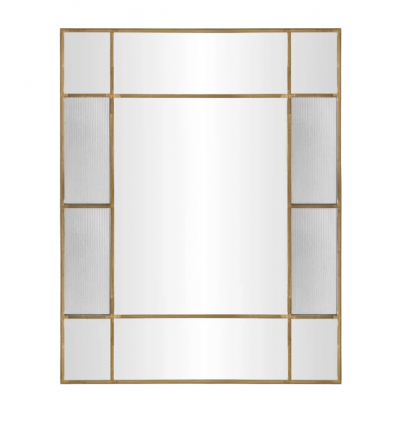
Mirrors, glazed ceramics and metallic details help distribute light more evenly. A mirror placed opposite a window can draw daylight further into the room. Positioned at the end of a hallway, it can soften what might otherwise feel like a dark stop. Above a fireplace, it can lift and brighten a focal point. Below you can see this working to great effect with the Fenton Mirror from Industville.

However, always consider what the mirror reflects as although the mirror itself might be in the perfect spot, what is it reflecting might be less than ideal!

Artificial Light Shapes the Evening

Natural light is only half the story. The way your home feels in the evening matters just as much.

Layered lighting creates flexibility:

  • Ambient lighting provides overall glow.
  • Task lighting supports function.
  • Accent lighting highlights architectural details or artwork.

Colour temperature should be chosen carefully. Very warm bulbs can distort neutral paint colours. Very cool bulbs can flatten texture. A balanced warm white usually works best in living spaces, while kitchens and utility areas may benefit from slightly brighter clarity.

If you need help using light in your interiors, get in touch. And for more interior design ideas and practical advice, follow us on Facebook.